 SAP-C03 Practice Exam
SAP-C03 Domain 1: Architecture Design and Implementation Built for the Cloud
25% of the scored content, about 16 of the 65 scored questions. 5 tasks and 34 skills, 16 of them new in SAP-C03. Our bank has 75 questions on this domain, 10 of them free.
- Task 1.1: Design architectures built for the cloud 35 questions
- Task 1.2: Integrate AI and ML services into architectures 11 questions
- Task 1.3: Design hybrid cloud integration patterns 7 questions
- Task 1.4: Design network architectures 10 questions
- Task 1.5: Design data, storage, and database architectures 12 questions
Facts that decide Domain 1 questions
Most wrong answers in this domain use the right service and miss one of these rules.
- An S3 bucket accepts only one event notification per event type for overlapping prefixes. Independent consumers of the same objects need EventBridge enabled on the bucket, with one rule per consumer.
- SQS FIFO keeps order within a message group ID and removes duplicates sent within a 5-minute deduplication interval; standard queues deliver at least once, so consumers must be idempotent.
- Step Functions Standard workflows run for up to one year with exactly-once execution and support .waitForTaskToken; Express workflows run for up to five minutes. A multi-day approval points to Standard workflows or durable Lambda functions, never Express.
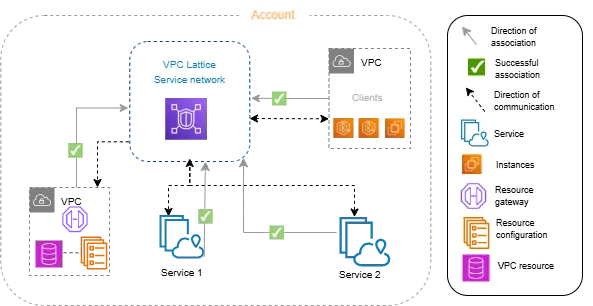
- VPC Lattice connects services across VPCs and accounts, including VPCs with overlapping CIDRs, without peering or a transit gateway, and applies IAM auth policies per service.
- CloudFront Functions run on viewer events only, have no network access and finish in under a millisecond; anything that calls another service or runs on origin events needs Lambda@Edge.
- Bedrock Knowledge Bases manages ingestion, chunking, embeddings and retrieval for RAG on a vector store; Bedrock AgentCore supplies the runtime, gateway, memory and identity for agents that call tools.
Task 1.1: Design architectures built for the cloud
Moved here from SAP-C02 — Task 1.4: cross-account and cross-Region event routing patterns; Task 2.4: stateless applications with externalized state management, auto scaling patterns for serverless and containerized workloads; Task 3.3: edge architectures for latency requirements; Task 4.4: event-driven architectures (messaging patterns, idempotency, ordering), container orchestration for microservices.
| Skill | What the guide says you must do | Our questions |
|---|---|---|
| 1.1.1 | Design event-driven architectures that use appropriate messaging patterns such as idempotency, ordering, and delivery guarantees (for example, by using Amazon EventBridge, Amazon SQS FIFO queues and standard queues, Amazon SNS, Amazon Kinesis with partition keys). | 3 |
| 1.1.2 | Design stateless applications that use externalized state management (for example, by using Amazon DynamoDB, Amazon S3, Amazon ElastiCache). | 3 |
| 1.1.3 | Design serverless data processing and analysis pipelines (for example, by using Amazon Kinesis Data Streams, AWS Glue, Amazon Athena, AWS Lambda). New | 2 |
| 1.1.4 | Design multi-step workflows that have durable execution patterns (for example, by using AWS Step Functions, durable Lambda functions). New | 4 |
| 1.1.5 | Implement cross-account and cross-Region event routing patterns that use event buses and event forwarding. | 3 |
| 1.1.6 | Design container orchestration for microservices by using managed services (for example, Amazon EKS, Amazon ECS, AWS Fargate). | 3 |
| 1.1.7 | Design service mesh architectures that facilitate microservice communication and observability (for example, by using Amazon VPC Lattice, Amazon ECS Service Connect). New | 3 |
| 1.1.8 | Manage container images by configuring security scans and lifecycle policies (for example, by using Amazon ECR). New | 2 |
| 1.1.9 | Design auto scaling patterns for serverless and containerized workloads (for example, by using Lambda concurrency, Horizontal Pod Autoscaler, Cluster Autoscaler, Amazon ECS service auto scaling, AWS Application Auto Scaling). | 3 |
| 1.1.10 | Design ingress patterns and optimize resources for specific usage patterns (for example, Application Load Balancer, Network Load Balancer, AWS Load Balancer Controller, Amazon API Gateway). New | 2 |
| 1.1.11 | Design edge architectures to meet latency requirements (for example, by using Amazon CloudFront Functions, Lambda@Edge). | 2 |
| 1.1.12 | Design architectures that support real-time data processing by using WebSocket and publish-subscribe patterns (for example, by using API Gateway WebSocket APIs). New | 2 |
| 1.1.13 | Design multi-tenant architectures that use tenant isolation patterns (for example, siloed or pooled resources, Amazon Cognito tenant context, row-level security, tenant-specific encryption). New | 3 |
Task 1.2: Integrate AI and ML services into architectures
| Skill | What the guide says you must do | Our questions |
|---|---|---|
| 1.2.1 | Design generative AI integrations for applications, including for multi-account deployment patterns (for example, by using Amazon Bedrock). New | 3 |
| 1.2.2 | Design AI agent architectures that integrate with tools (for example, by using Amazon Bedrock AgentCore, Amazon Bedrock Knowledge Bases). New | 3 |
| 1.2.3 | Design ML inference architectures (for example, Amazon SageMaker AI endpoints). New | 2 |
| 1.2.4 | Design RAG architectures, including ingestion and retrieval strategies (for example, Amazon Bedrock knowledge bases that use vector stores). New | 3 |
Task 1.3: Design hybrid cloud integration patterns
Moved here from SAP-C02 — Task 4.2: data synchronization strategies for hybrid workloads; Task 4.4: integration patterns to modernize legacy systems.
| Skill | What the guide says you must do | Our questions |
|---|---|---|
| 1.3.1 | Design hybrid connectivity that provides redundancy and failover capabilities (for example, by using AWS Direct Connect, AWS VPN, AWS Transit Gateway). | 2 |
| 1.3.2 | Design data synchronization strategies for hybrid workloads (for example, by using AWS DataSync, AWS Storage Gateway, AWS Transfer Family). | 2 |
| 1.3.3 | Design integration patterns to modernize legacy systems by using data transformations (for example, by using API Gateway, Lambda, Amazon MQ). | 1 |
| 1.3.4 | Design DNS solutions for hybrid environments (for example, by using Amazon Route 53 Resolver endpoints, Route 53 private hosted zones, split-horizon DNS, conditional forwarding). | 1 |
| 1.3.5 | Design hybrid compute patterns (for example, by using Amazon EKS Anywhere, Amazon ECS Anywhere, AWS Outposts, AWS Local Zones). New | 1 |
Task 1.4: Design network architectures
Moved here from SAP-C02 — Task 1.1: vPC architectures with subnet strategies and IP address management; Task 1.2: network security architectures (traffic inspection, filtering).
| Skill | What the guide says you must do | Our questions |
|---|---|---|
| 1.4.1 | Design multi-VPC architectures that provide hybrid and multi-account connectivity (for example, VPC peering, AWS PrivateLink). | 2 |
| 1.4.2 | Design VPC architectures by using subnet strategies, IP address management, and network segmentation (for example, by using Amazon VPC IP Address Manager [IPAM], public and private subnets). | 2 |
| 1.4.3 | Design network security architectures that include traffic inspection, traffic filtering, and application layer protection (for example, by using AWS Network Firewall, AWS WAF, Gateway Load Balancers, security groups, network ACLs, VPC Flow Logs). | 2 |
| 1.4.4 | Design IPv6 adoption and dual-stack migration strategies. New | 2 |
| 1.4.5 | Design global traffic routing strategies for multi-Region applications (for example, by using Route 53 routing policies, AWS Global Accelerator). | 2 |
Task 1.5: Design data, storage, and database architectures
Moved here from SAP-C02 — Task 2.4: database scaling solutions for high availability.
| Skill | What the guide says you must do | Our questions |
|---|---|---|
| 1.5.1 | Design data lake and lakehouse architectures (for example, by using Amazon S3, AWS Lake Formation, Amazon Redshift Spectrum, Apache Iceberg). New | 2 |
| 1.5.2 | Design real-time and batch analytics pipelines (for example, by using Amazon EMR, Amazon Redshift, Amazon Managed Streaming for Apache Kafka [Amazon MSK], Amazon AppFlow). New | 1 |
| 1.5.3 | Select appropriate database services based on workload requirements such as access patterns, consistency needs, and scalability (for example, Amazon RDS, Amazon Aurora, Amazon DynamoDB, Amazon Redshift). | 1 |
| 1.5.4 | Design database scaling solutions to provide high availability (for example, by using read replicas, Amazon Aurora Global Database, Amazon DynamoDB global tables, Amazon RDS Multi-AZ deployments). | 2 |
| 1.5.5 | Design storage architectures based on access patterns and performance requirements (for example, by using Amazon S3, Amazon EBS, Amazon EFS, Amazon FSx). | 2 |
| 1.5.6 | Design data caching strategies to optimize performance (for example, by using ElastiCache, DynamoDB Accelerator [DAX]). | 2 |
| 1.5.7 | Design data cataloging and cross-account data sharing patterns (for example, AWS Glue Data Catalog, Lake Formation, AWS Clean Rooms). New | 2 |
Free Domain 1 questions with answers
- Question 1 (skill 1.1.1): A media company stores uploaded video files in an Amazon S3 bucket.
- Question 2 (skill 1.1.3): A retail company collects clickstream events as JSON records from its website at roughly 5,000 records per second.
- Question 3 (skill 1.1.5): A company uses AWS Organizations with more than 300 accounts, and new accounts are created every week.
- Question 4 (skill 1.1.7): A company has microservices spread across 15 AWS accounts.
- Question 5 (skill 1.1.10): A company runs 35 microservices on Amazon EKS.
- Question 6 (skill 1.1.13): A B2B SaaS provider stores data for 900 tenants in a single Amazon Aurora PostgreSQL cluster.
- Question 7 (skill 1.2.3): A medical imaging company runs a computer vision model that analyzes scans submitted by clinics.
- Question 8 (skill 1.3.2): An engineering firm stores CAD project files on an on-premises Windows NAS that is almost full.
- Question 9 (skill 1.4.3): A company uses a centralized inspection VPC attached to a transit gateway.
- Question 10 (skill 1.5.2): A payments company publishes card transaction events to an existing Amazon MSK cluster at up to 30,000 events per second.