 SAP-C03 Practice Exam
SAP-C03 Domain 3: Cost-Optimized Architecture Design
15% of the scored content, about 10 of the 65 scored questions. 4 tasks and 19 skills, 3 of them new in SAP-C03. Our bank has 45 questions on this domain, 6 of them free.
- Task 3.1: Design architectures based on AWS pricing models 14 questions
- Task 3.2: Optimize data transfer and network costs 10 questions
- Task 3.3: Design cost allocation and visibility solutions 8 questions
- Task 3.4: Optimize storage and database costs 13 questions
Facts that decide Domain 3 questions
Most wrong answers in this domain use the right service and miss one of these rules.
- Compute Savings Plans cover EC2 in any family and Region plus Fargate and Lambda; EC2 Instance Savings Plans give a deeper discount but stay within one instance family in one Region.
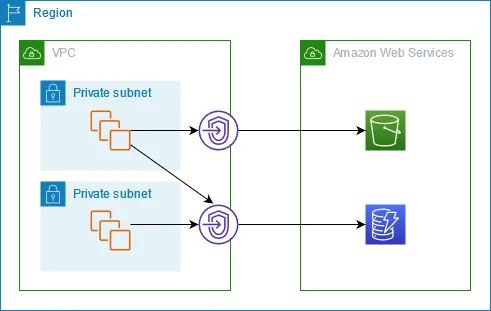
- Gateway VPC endpoints for S3 and DynamoDB have no hourly or per-GB charge, while a NAT gateway charges for every GB it processes; heavy S3 traffic from private subnets is a gateway-endpoint answer.
- Bedrock batch inference is priced below on-demand for supported models and suits work that can wait for results; prompt caching cuts cost on repeated prompt prefixes.
- Cost allocation tags appear in Cost Explorer and the Cost and Usage Report only after they are activated in the Billing console; tag policies keep tag keys and values consistent across accounts.
- S3 Intelligent-Tiering charges a per-object monitoring fee and no retrieval fees, and does not auto-tier objects smaller than 128 KB.
- gp3 volumes set IOPS and throughput independently of size; a gp2 volume that was enlarged only to get IOPS is usually cheaper as a smaller gp3 volume.
Task 3.1: Design architectures based on AWS pricing models
Moved here from SAP-C02 — Task 2.5: rightsizing and scaling strategies based on performance; Task 2.6: cost-optimized architectures for workload requirements (Graviton, Step Functions, Lambda).
| Skill | What the guide says you must do | Our questions |
|---|---|---|
| 3.1.1 | Select appropriate purchase options based on usage patterns, including commitment- based and capacity-based options (for example, provisioned capacity, Reserved Instances, AWS Savings Plans, Spot Instances, On-Demand Instances). | 3 |
| 3.1.2 | Design cost-optimized architectures to meet workload requirements (for example, by using Graviton-based instances, AWS Step Functions Standard Workflows or Express Workflows, AWS Lambda functions). | 3 |
| 3.1.3 | Implement rightsizing and scaling strategies based on performance metrics (for example, by using AWS Compute Optimizer, scheduled scaling, target tracking policies, AWS Fargate Spot). | 3 |
| 3.1.4 | Optimize costs for AI/ML workloads by selecting the appropriate service tier, implementing batching strategies, and designing caching patterns (for example, by using Amazon Bedrock, Amazon SageMaker AI). New | 5 |
Task 3.2: Optimize data transfer and network costs
Moved here from SAP-C02 — Task 2.6: data transfer cost optimization (private connectivity, Regional patterns), cost-aware multi-Region data replication, cost-effective network architectures (AWS Transit Gateway, AWS PrivateLink pricing); Task 3.3: content delivery architectures and caching strategies.
| Skill | What the guide says you must do | Our questions |
|---|---|---|
| 3.2.1 | Design content delivery architectures, origin selection strategies, caching strategies, and failover patterns (for example, by using Amazon CloudFront, Amazon CloudFront Origin Shield). | 2 |
| 3.2.2 | Optimize data transfer costs by using strategies such as private connectivity, Regional traffic patterns, and inter-Availability Zone/inter-Region strategies (for example, by using VPC endpoints, NAT gateways, Availability Zone-aware architectures). | 2 |
| 3.2.3 | Configure cost-aware, multi-Region data replication (for example, by using Amazon S3 Cross-Region Replication, Amazon DynamoDB global tables). | 2 |
| 3.2.4 | Design cost-effective network architectures (for example, by using AWS Transit Gateway data processing charges, AWS PrivateLink pricing models). | 2 |
| 3.2.5 | Optimize data transfer costs for AI/ML workloads by using strategies such as cross- Region inference routing. New | 2 |
Task 3.3: Design cost allocation and visibility solutions
Moved here from SAP-C02 — Task 1.5: policy-based tagging enforcement for cost allocation; Task 3.5: chargeback and showback capabilities, cost monitoring and alerting solutions (budgets, anomaly detection).
| Skill | What the guide says you must do | Our questions |
|---|---|---|
| 3.3.1 | Design tagging strategies for cost allocation (for example, by using tags for business units, projects, and environments). | 1 |
| 3.3.2 | Configure cost reporting and analytics solutions that use detailed billing data (for example, by using AWS Cost Explorer, AWS Cost and Usage Reports). | 2 |
| 3.3.3 | Implement policy-based tagging enforcement for cost allocation (for example, by using SCPs, AWS Config rules, tag policies). | 1 |
| 3.3.4 | Implement chargeback and showback capabilities for cost allocation (for example, by using cost categories, split cost allocation, token usage monitoring for Amazon Bedrock). | 3 |
| 3.3.5 | Configure cost monitoring and alerting solutions that include budget thresholds and anomaly detection (for example, by using AWS Budgets, AWS Cost Anomaly Detection). | 1 |
Task 3.4: Optimize storage and database costs
Moved here from SAP-C02 — Task 1.3: backup and disaster recovery with cost-optimized retention; Task 2.6: database cost optimization (capacity modes, reserved capacity), intelligent storage tiering and lifecycle policies; Task 3.5: block storage cost optimization.
| Skill | What the guide says you must do | Our questions |
|---|---|---|
| 3.4.1 | Implement intelligent storage tiering and lifecycle policies (for example, by using Amazon S3 Intelligent-Tiering, S3 Lifecycle policies, S3 Glacier storage classes, Amazon EFS lifecycle policies). | 3 |
| 3.4.2 | Optimize block storage costs by selecting appropriate volume types and provisioning appropriate input/output operations per second (IOPS) (for example, Amazon EBS gp3 volumes, EBS gp2 volumes, Provisioned IOPS). | 2 |
| 3.4.3 | Optimize database costs by selecting appropriate capacity modes and reserved capacity (for example, DynamoDB capacity modes, Amazon RDS reserved DB instances, Amazon Aurora serverless, Aurora I/O-Optimized, Database Savings Plans). | 3 |
| 3.4.4 | Implement backup and disaster recovery mechanisms that use cost-optimized retention policies (for example, by using AWS Backup, Amazon Data Lifecycle Manager). | 2 |
| 3.4.5 | Design cost-effective observability solutions that include features such as log filtering, metric aggregation, and retention optimization. New | 3 |
Free Domain 3 questions with answers
- Question 21 (skill 3.1.1): A media company runs a steady baseline of about $40 per hour of compute on Amazon EC2 m6i instances in us-east-1.
- Question 22 (skill 3.1.3): A company has 1,800 Amazon EC2 instances across 60 accounts in AWS Organizations.
- Question 23 (skill 3.2.3): A healthcare company stores 900 TB in an Amazon S3 bucket in us-east-1.
- Question 24 (skill 3.2.5): A European bank runs a document assistant that calls a foundation model through Amazon Bedrock on-demand inference in eu-central-1.
- Question 25 (skill 3.3.4): A software company runs a single large Amazon EKS cluster on Amazon EC2 nodes that is shared by 15 product teams, each deployed to its own…
- Question 26 (skill 3.4.2): A logistics company runs a self-managed PostgreSQL database on Amazon EC2 with a 2 TiB gp2 Amazon EBS data volume.
Domain 2: Security and governance · Domain 4: Resilience and migration