 SAP-C03 Practice Exam
SAP-C03 Domain 4: Resilience, Migration, and Business Continuity
15% of the scored content, about 10 of the 65 scored questions. 3 tasks and 17 skills, 1 of them new in SAP-C03. Our bank has 45 questions on this domain, 6 of them free.
- Task 4.1: Design migration strategies by using AWS frameworks 18 questions
- Task 4.2: Design disaster recovery architectures 17 questions
- Task 4.3: Design solutions to meet business continuity and resiliency requirements 10 questions
Facts that decide Domain 4 questions
Most wrong answers in this domain use the right service and miss one of these rules.
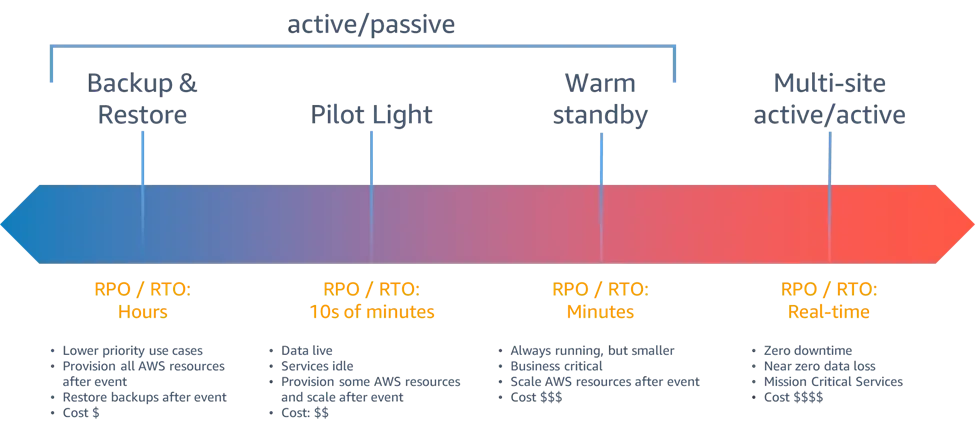
- Match the disaster recovery strategy to the stated RTO and RPO: backup and restore (hours), pilot light (tens of minutes), warm standby (minutes), multi-site active/active (near zero).
- Aurora Global Database replicates at the storage layer with typical lag under one second and supports managed cross-Region switchover; a cross-Region read replica of RDS needs manual promotion.
- AWS Elastic Disaster Recovery replicates block storage continuously for an RPO in seconds and launches recovery instances in minutes, without running a full standby fleet.
- Rehosting at scale is AWS Transform MGN (formerly AWS Application Migration Service); database moves with minimal downtime use AWS DMS with change data capture, plus AWS SCT when the engine changes.
- AWS Fault Injection Service runs controlled experiments with stop conditions tied to CloudWatch alarms; Route 53 Application Recovery Controller zonal shift moves traffic away from an impaired Availability Zone.
- AWS Backup Vault Lock in compliance mode prevents anyone, including the root user, from deleting recovery points before retention ends.
Task 4.1: Design migration strategies by using AWS frameworks
Moved here from SAP-C02 — Task 4.2: rehosting strategies; Task 4.4: refactor strategies (microservices decomposition, serverless adoption), modernize legacy workloads (mainframes, applications, databases).
| Skill | What the guide says you must do | Our questions |
|---|---|---|
| 4.1.1 | Design discovery and portfolio assessment solutions to map dependencies and plan migration waves. | 2 |
| 4.1.2 | Implement rehosting strategies (for example, by using AWS Transform MGN [previously known as AWS Application Migration Service], AWS Transform). | 4 |
| 4.1.3 | Design database and data migration strategies (for example, by using AWS Database Migration Service, AWS DataSync). | 4 |
| 4.1.4 | Design replatforming strategies that use managed services to reduce operational overhead (for example, Amazon RDS, Amazon Aurora, Amazon ECS, AWS Lambda). | 2 |
| 4.1.5 | Implement refactor strategies such as microservices decomposition, serverless adoption, and incremental modernization patterns (for example, strangler fig pattern). | 3 |
| 4.1.6 | Modernize legacy workloads, including mainframes, applications, and databases. | 3 |
Task 4.2: Design disaster recovery architectures
Moved here from SAP-C02 — Task 2.2: multi-Region disaster recovery solutions, disaster recovery testing and validation procedures; Task 3.1: disaster recovery assessment and recovery procedures.
| Skill | What the guide says you must do | Our questions |
|---|---|---|
| 4.2.1 | Design disaster recovery solutions to meet business requirements (for example, RTO, RPO, costs). | 2 |
| 4.2.2 | Configure continuous replication to recover quickly from incidents (for example, by using AWS Elastic Disaster Recovery). | 2 |
| 4.2.3 | Establish disaster recovery assessment and recovery procedures (for example, by using AWS Resilience Hub, AWS Systems Manager runbooks). | 2 |
| 4.2.4 | Implement multi-Region disaster recovery solutions that include features such as data replication and failover (for example, by using Amazon Route 53 health checks, AWS Global Accelerator, Amazon Application Recovery Controller). | 3 |
| 4.2.5 | Establish disaster recovery testing and validation procedures (for example, by using AWS Resilience Hub). | 2 |
| 4.2.6 | Implement multi-cluster container strategies to provide high availability and disaster recovery (for example, by using Amazon EKS, Amazon ECS). New | 6 |
Task 4.3: Design solutions to meet business continuity and resiliency requirements
Moved here from SAP-C02 — Task 1.4: centralized backup governance and cross-account backup policies; Task 3.1: failover tests and recovery time measurement (AWS Fault Injection Service, Amazon Route 53), chaos engineering with controlled failure scenarios; Task 3.2: data protection against ransomware and accidental deletion.
| Skill | What the guide says you must do | Our questions |
|---|---|---|
| 4.3.1 | Configure centralized backup governance and cross-account backup policies (for example, by using AWS Backup). | 2 |
| 4.3.2 | Design failover tests and measure recovery times (for example, by using AWS Fault Injection Service, Amazon Route 53 health checks). | 2 |
| 4.3.3 | Design technically resilient architectures that have features such as redundancy, fault tolerance, and self-healing capabilities. | 2 |
| 4.3.4 | Protect data against ransomware and accidental deletion (for example, by using Amazon S3 Object Lock, Amazon EBS snapshot lock, AWS Backup Vault Lock). | 3 |
| 4.3.5 | Implement chaos engineering with controlled failure scenarios (for example, by using AWS Fault Injection Service experiment templates, steady-state hypotheses). | 1 |
Free Domain 4 questions with answers
- Question 27 (skill 4.1.1): A manufacturer plans to migrate 400 workloads out of its data center by using AWS Transform.
- Question 28 (skill 4.1.2): A company runs 3,000 virtual machines on VMware vSphere with VMware NSX networking.
- Question 29 (skill 4.1.5): An insurance company runs a large Java monolith on Amazon EC2 instances behind an Application Load Balancer.
- Question 30 (skill 4.1.6): A software company runs a line-of-business application on Microsoft SQL Server Enterprise Edition in its data center.
- Question 31 (skill 4.2.4): A payments company runs an active-passive workload in us-east-1 and us-west-2 with Amazon Route 53 DNS records pointing to each Region.
- Question 32 (skill 4.3.2): An e-commerce company runs its checkout service on Amazon EC2 instances in three Availability Zones behind an Application Load Balancer, with an…
Domain 3: Cost optimization · Domain 5: Operations and automation