 SAP-C03 Practice Exam
SAP-C03 Domain 5: Operational Excellence and Automation
20% of the scored content, about 13 of the 65 scored questions. 4 tasks and 21 skills, 8 of them new in SAP-C03. Our bank has 60 questions on this domain, 8 of them free.
- Task 5.1: Design infrastructure as code 12 questions
- Task 5.2: Design CI/CD and DevSecOps pipelines 16 questions
- Task 5.3: Design observability and monitoring solutions 18 questions
- Task 5.4: Design operational automation and resilient systems 14 questions
Facts that decide Domain 5 questions
Most wrong answers in this domain use the right service and miss one of these rules.
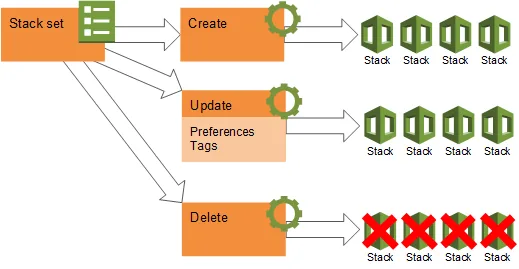
- CloudFormation StackSets with service-managed permissions deploy automatically to every new account added to a target OU.
- A cross-account CodePipeline needs a customer managed KMS key for its artifact bucket, shared with the target accounts; the default AWS managed key cannot be used across accounts.
- CloudWatch Synthetics canaries run scripted transactions on a schedule; CloudWatch RUM measures what real users' browsers experience. A scenario with no traffic at night points to canaries.
- Systems Manager Automation and Run Command take rate controls (maximum concurrency and error threshold), which is how a fleet-wide fix stops itself before it takes the service down.
- Predictive scaling forecasts daily and weekly patterns and adds capacity ahead of demand; target tracking reacts to the current metric.
- Amazon Bedrock Evaluations scores models and knowledge bases with automatic metrics, a judge model or human reviewers, so a release pipeline can gate on output quality.
Task 5.1: Design infrastructure as code
Moved here from SAP-C02 — Task 1.4: multi-account and multi-Region infrastructure deployments; Task 2.1: infrastructure as code (declarative and imperative approaches); Task 3.2: policy as code for validation, enforcement, and drift remediation, secrets management in infrastructure code.
| Skill | What the guide says you must do | Our questions |
|---|---|---|
| 5.1.1 | Implement infrastructure as code by using declarative and imperative approaches (for example, AWS CloudFormation, AWS CDK). | 2 |
| 5.1.2 | Design policy as code to perform proactive validation, enforcement, and drift remediation (for example, by using AWS CloudFormation Hooks, AWS CDK aspects, AWS Config rules, SCPs). | 4 |
| 5.1.3 | Manage secrets in infrastructure code (for example, by using AWS Secrets Manager, AWS Systems Manager Parameter Store). | 3 |
| 5.1.4 | Design multi-account and multi-Region infrastructure deployments (for example, by using CloudFormation StackSets). | 3 |
Task 5.2: Design CI/CD and DevSecOps pipelines
Moved here from SAP-C02 — Task 2.1: cI/CD solutions for automated build and deployment pipelines.
| Skill | What the guide says you must do | Our questions |
|---|---|---|
| 5.2.1 | Design CI/CD solutions to orchestrate automated build and deployment pipelines (for example, by using AWS CodePipeline, AWS CodeBuild, AWS CodeDeploy, AWS CodeCommit). | 2 |
| 5.2.2 | Implement security scanning in pipelines to assess vulnerabilities and sign artifacts (for example, by using Amazon Inspector, Amazon ECR image scanning). New | 3 |
| 5.2.3 | Configure multi-account and multi-Region deployment pipelines that include features such as role delegation and artifact promotion (for example, by using CodePipeline cross-account deployments). New | 5 |
| 5.2.4 | Evaluate AI/ML applications and validate outputs (for example, by using Amazon Bedrock Evaluations). New | 3 |
| 5.2.5 | Implement deployment strategies that provide rollback capabilities (for example, blue/green, canary, rolling deployments). | 3 |
Task 5.3: Design observability and monitoring solutions
Moved here from SAP-C02 — Task 1.4: multi-account log aggregation with cross-account subscriptions; Task 3.1: observability with metrics, logs, and distributed tracing; Task 3.3: service-level objectives (SLOs) with measurable indicators.
| Skill | What the guide says you must do | Our questions |
|---|---|---|
| 5.3.1 | Implement observability by collecting metrics, logs, and distributed tracing by using standardized instrumentation (for example, by using Amazon CloudWatch, AWS X-Ray, AWS Distro for OpenTelemetry). | 3 |
| 5.3.2 | Implement monitoring for containerized applications (for example, by using Amazon ECS, Amazon EKS with Container Insights). New | 3 |
| 5.3.3 | Implement multi-account log aggregation with cross-account subscriptions and centralized archives (for example, by using Amazon CloudWatch Logs subscriptions, Amazon S3 archival storage tiers). | 2 |
| 5.3.4 | Configure alerting solutions (for example, by using CloudWatch alarms, Amazon SNS, AWS Systems Manager). | 3 |
| 5.3.5 | Monitor metrics for AI/ML workloads, including model performance, AI agent performance, inference latency, and model drift. New | 3 |
| 5.3.6 | Design monitoring solutions for the user experience by using strategies such as synthetic transactions and real user monitoring (for example, by using Amazon CloudWatch Synthetics, Amazon CloudWatch RUM). New | 2 |
| 5.3.7 | Design service-level objectives (SLOs) that have measurable indicators and alerts (for example, by using CloudWatch, CloudWatch Application Signals). | 2 |
Task 5.4: Design operational automation and resilient systems
Moved here from SAP-C02 — Task 2.4: auto scaling policies (target tracking, predictive scaling); Task 3.1: health monitoring, capacity planning, and operational responses.
| Skill | What the guide says you must do | Our questions |
|---|---|---|
| 5.4.1 | Implement health monitoring, capacity planning, and operational responses (for example, by using CloudWatch alarms, Amazon EventBridge, AWS Systems Manager, Service Quotas). | 3 |
| 5.4.2 | Configure controlled remediation solutions that have safety constraints (for example, circuit breakers, rate limits, bulkhead patterns, retry patterns with exponential backoff). New | 4 |
| 5.4.3 | Configure auto scaling policies that are based on metrics and scheduled scaling policies (for example, target tracking scaling, predictive scaling for Auto Scaling groups). | 3 |
| 5.4.4 | Design automated failure recovery solutions that use health checks and replacement strategies (for example, by using Auto Scaling health checks, Amazon ECS task replacement, AWS Lambda retry policies). | 2 |
| 5.4.5 | Configure automated runbooks and incident response procedures for operational tasks such as patching, remediation, and scaling. New | 2 |
Free Domain 5 questions with answers
- Question 33 (skill 5.1.1): A platform team supports 40 product teams that write application code in TypeScript.
- Question 34 (skill 5.1.3): In a single account, a network stack exports VPC and subnet IDs that 25 application stacks consume with Fn::ImportValue.
- Question 35 (skill 5.2.2): A company deploys container images from Amazon ECR to Amazon EKS.
- Question 36 (skill 5.2.3): A company runs an application on Amazon ECS in us-east-1 and eu-west-1 in the same account.
- Question 37 (skill 5.3.1): A logistics company runs 40 microservices written in Java, Python, and Go across Amazon EKS, Amazon ECS on AWS Fargate, and AWS Lambda.
- Question 38 (skill 5.3.4): An e-commerce company has separate CloudWatch alarms for ALB 5XX errors, p99 latency, and Amazon RDS CPU utilization for its checkout service.
- Question 39 (skill 5.3.7): A payments company runs its order API on Amazon EKS.
- Question 40 (skill 5.4.2): A company must apply a configuration remediation script to 4,000 managed EC2 instances that run a customer-facing service behind load balancers.